How to buy property in Panama: a step-by-step guide
- Panama Investors
- 2 days ago
- 8 min read

Panama is one of the few places in the world where a foreign buyer can close on a beachfront condo for under $200,000, earn 5 to 8% annual rental yields, and do it all in U.S. dollars. That combination is rare. But the process is not automatic. Unclear property titles, infrastructure gaps in coastal areas, and unfamiliar legal steps catch too many international buyers off guard. This guide walks you through everything: what documents you need, how to find the right property, how the closing process works, and which mistakes to avoid before you wire a single dollar.
Table of Contents
Key Takeaways
Point | Details |
Preparation is essential | Having the right documents and pre-approvals simplifies the buying process and opens more property options. |
Market varies by location | Panama City and beach areas like Coronado offer the strongest investment returns and value for buyers. |
Legal due diligence is critical | Hiring local legal counsel for title verification and contract review prevents costly mistakes. |
Know the pitfalls | Infrastructure gaps and unclear titles are the most common problems—verify everything before sending money. |
What you need before buying: Requirements and preparation
Before you start browsing listings, you need to get your paperwork in order. Panama is genuinely open to foreign buyers. You have the same legal right to own property here as a Panamanian citizen. But local banks and sellers still want to see that you are a credible buyer.
Here are the core documents you will need:
Valid passport (and a copy notarized in your home country if applying for financing)
Proof of income (last 2 years of tax returns, pay stubs, or business financials)
Proof of funds (bank statements showing your down payment and reserves)
Reference letters from your current bank (required by most Panamanian lenders)
Credit history from your home country (translated into Spanish if needed)
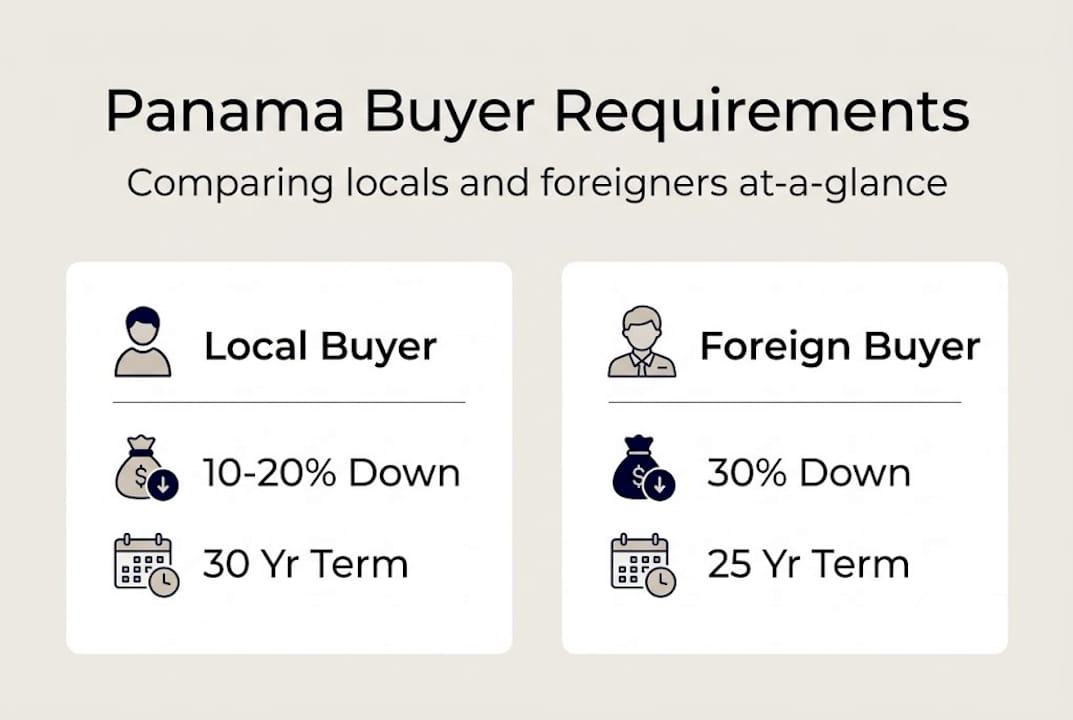
If you plan to finance locally, Panamanian banks offer mortgages to foreigners at roughly 30% down, terms up to 25 years, and interest rates around 6%. That is a workable structure for most investors, but the income verification requirements are strict. Self-employed buyers should prepare at least two years of certified financials.
Requirement | Local buyer | Foreign buyer |
Minimum down payment | 10-20% | 30% |
Max loan term | 30 years | 25 years |
Interest rate (approx.) | 5-6% | 6-7% |
Proof of income required | Yes | Yes |
Local bank account needed | Optional | Recommended |
Pre-approval is worth pursuing before you tour properties. It sharpens your negotiating position and tells sellers you are serious. You should also hire a local attorney before you sign anything. Panama’s legal system is in Spanish, and contract nuances matter enormously. Reviewing the foreign buyer steps in detail before your first meeting with a seller will save you time and money. Some investors also use property purchases to qualify for residency through investment, which adds another layer of planning to consider early.
Pro Tip: Always hire bilingual legal counsel, not just a translator. A lawyer who practices in both English and Spanish will catch contract clauses that a translator might miss entirely.
Finding the best investment property in Panama
Once you are ready, location is everything. Panama is not a single market. It is several distinct markets with very different risk profiles, price points, and rental demand patterns.
Panama City is the most liquid market. Mid-range neighborhoods like El Cangrejo, Costa del Este, and Marbella attract corporate tenants and long-term expat renters. Prices in these areas range from $800 to $1,900 per square meter, depending on the building and floor. Vacancy rates are lower here, and resale is faster.
Coronado is the most popular beach market for investors on a budget. Two-bedroom condos typically sell between $80,000 and $220,000, with rental yields averaging 5 to 8%. The trade-off is that rental demand is more seasonal, and you are betting on tourism and weekend traffic from Panama City.
Rural and interior regions like Boquete and El Valle offer the lowest entry prices, sometimes under $100,000 for a house with land. But these markets are illiquid. Resale can take years, and rental demand is thin outside of niche expat communities.
Here is a quick comparison of new builds versus resale properties:
Factor | New build | Resale |
Property tax exemption | 5 to 20 years | Usually none |
Title transfer timing | After construction | Immediate |
Price negotiability | Limited | Higher |
Infrastructure risk | Lower (urban) | Varies |
Rental income start | Delayed | Immediate |
New builds in Panama City often come with significant real estate tax benefits that can save you thousands over the first decade. Resale properties give you immediate title and rental income, which is better for cash flow investors. Panama consistently ranks as a top investment destination in Latin America for exactly these reasons: the options are genuinely diverse.
Pro Tip: If you are looking at a beach or rural property, visit during the rainy season. Infrastructure problems like road flooding, water pressure issues, and power outages are much easier to spot in May than in January.
The property buying process: Step-by-step overview
Once you have found a property you want, the purchase process moves in a clear sequence. Most buyers close in 3 to 8 weeks when documents are in order.
Make a verbal offer and agree on a price with the seller or their agent.
Sign a promissory contract (Promesa de Compraventa), which locks in the price and terms. A deposit of 3 to 10% is standard at this stage.
Hire a notary and attorney to begin due diligence. Your lawyer will review the title at the Public Registry.
Complete due diligence, including title verification, lien checks, and confirmation that there are no outstanding debts on the property.
Secure financing (if applicable) and get final bank approval.
Sign the public deed (Escritura Pública) before a Panamanian notary.
Register the deed at the Public Registry. This is the step that legally transfers ownership to you.
Here is what to expect in terms of costs at closing:
Cost item | Typical amount |
Transfer tax | 2% of property value |
Notary and legal fees | 1-2% of property value |
Real estate agent commission | 3-5% (usually paid by seller) |
Registration fee | ~0.3% of property value |
Mortgage stamp tax | 0.1% of loan amount |
One important distinction: new builds offer tax exemptions lasting 5 to 20 years on property tax, while resale properties may owe taxes immediately after transfer. That difference can significantly affect your net return in the first years of ownership. The full step-by-step buying guide covers each of these stages in greater detail if you want to go deeper before your first call with an advisor.
Common pitfalls and how to avoid them
The buying process is not without its risks. Here is how to spot and avoid common problems before they cost you.
The most serious risk in Panama is unclear or encumbered title. Some properties, especially in rural areas and older coastal developments, have title disputes, unpaid liens, or rights-of-way that do not show up in casual searches. Always require your attorney to run an independent title search at the Public Registry before you sign a promissory contract.
Other common pitfalls include:
Infrastructure gaps in remote areas: Beach and rural properties often lack reliable water, power, or road access. These are not minor inconveniences for rental properties.
Overlooking HOA and maintenance fees: Some condo developments in Panama City charge $300 to $600 per month in fees. These eat directly into your rental yield.
Skipping developer due diligence: For new builds, check the developer’s track record. Delays of 12 to 24 months beyond projected delivery are common with smaller developers.
Ignoring currency risk: Panama uses the U.S. dollar, so there is no exchange risk for American investors. But buyers from Europe or Asia should factor in their home currency exposure.
Underestimating vacancy periods: Seasonal beach markets can sit empty for 3 to 4 months per year. Model your returns conservatively.
Reviewing Panama’s infrastructure landscape before committing to a specific region is a smart first step. If you are comparing Panama to other markets, a side-by-side look at Panama vs Costa Rica vs Colombia can help you confirm you are making the right regional choice.
“The biggest mistake I see foreign buyers make is falling in love with a view before they verify the title. A beautiful property with a clouded title is a liability, not an asset.” — Luca Piva, Panama Investors
Pro Tip: Always require an independent legal title search, separate from any search the seller’s agent offers to arrange. The cost is minimal. The protection is not.
Our perspective: What smart investors get wrong about Panama real estate
After working with hundreds of international buyers, we have noticed a consistent pattern. The investors who struggle are not the ones who lacked capital. They are the ones who let the low price tag do all the thinking for them.
Panama’s affordability is real. But affordability does not guarantee returns. We have seen buyers purchase a $90,000 beach condo in a development with no rental management infrastructure, poor road access, and zero marketing to tourists. The property sits empty. Meanwhile, a client who paid $180,000 for a well-located Panama City unit with a proven rental history earns consistent 7% yields year after year.
The lesson is that Panama as a top investment destination rewards buyers who do their homework on neighborhood demand, not just price per square meter. Legal verification and infrastructure quality are not optional extras. They are the foundation of every successful deal we have been part of. The investors who get it right treat Panama like a business decision, not a lifestyle impulse.
Ready to invest in Panama? Talk to a local expert
Knowing the process is one thing. Executing it without the right local contacts is another challenge entirely. Panama’s best deals rarely appear on public listing sites, and negotiating with local sellers requires cultural fluency and market knowledge that takes years to build.
At Panama Investors, we connect international buyers with exclusive listings, vetted legal counsel, and a bilingual advisory team that has guided clients through every type of transaction in this market. Whether you are looking for a beach condo, a Panama City rental unit, or a longer-term residency strategy, we can tailor a plan to your goals. Book a free strategy call with our team at panamainvestors.com/call-us and get answers specific to your situation, not generic advice.
Frequently asked questions
Can foreigners buy property in Panama without residence?
Yes, foreigners can buy real estate in Panama without residency or citizenship, and they receive the same legal protections as Panamanian nationals under local law.
What is the minimum down payment for a mortgage in Panama?
Most Panamanian banks require a 30% minimum down payment from foreign buyers, with loan terms up to 25 years and interest rates around 6%.
How much are property taxes in Panama?
Many new properties qualify for property tax exemptions lasting 5 to 20 years, while resale properties may owe taxes immediately after the title transfer.
What are typical rental yields for investment properties in Panama?
Coronado beach condos average yields of 5 to 8%, while Panama City neighborhoods like El Cangrejo offer competitive returns depending on unit size and building quality.
Is legal representation required for foreigners buying property in Panama?
It is not legally required, but hiring a local attorney for title verification and contracts is strongly recommended to protect your investment and avoid costly errors.
Recommended



Comments